Europe is learning a hard lesson. When major powers begin using energy as a political weapon, countries that depend on imports can find themselves cornered. Today, the European Union faces that reality.
For decades, Europe has relied heavily on imported oil and gas. As domestic fields in places like the North Sea have declined and climate policies have phased out coal, the bloc’s dependence on foreign energy has grown. That reliance is now creating economic strain and geopolitical risk.
Rising Dependence on Imports
According to a Federal Reserve analysis cited by The Wall Street Journal, imports accounted for 50 percent of Europe’s energy needs in 1990. Today, that figure has climbed to 58 percent.
By comparison, China imports about 24 percent of its energy, and India about 37 percent, based on International Energy Agency data. Even at lower levels of dependence, Beijing views reliance on foreign energy as a serious vulnerability. China has responded by stockpiling oil and expanding wind and solar power. It has also leveraged its dominance in rare earth supply chains to strengthen its strategic position.
Europe, however, has struggled to reduce its exposure.
Energy as a Political Weapon
Europe’s dependence has already been used against it.
When Russia invaded Ukraine in 2022, Moscow shut off pipeline gas flows to the EU. The crisis sent energy prices soaring. In 2022 alone, the EU spent the equivalent of 3.8 percent of its gross domestic product on energy imports.
The European Council later described Russia’s actions as the “weaponisation of gas supplies with significant effects on the European energy market.” European Commission President Ursula von der Leyen declared, “Europe is closing the tap on Russian fossil fuels once and for all. Energy independence starts now.”
At the start of the war, Russia supplied about 27 percent of the EU’s crude oil, around 40 percent of its natural gas, and nearly half of its coal. Although coal imports were halted quickly and oil imports have fallen to less than 3 percent, gas has proven more difficult to replace. As recently as last year, Russia still supplied about 13 percent of the EU’s gas.
The EU now plans to halt imports of Russian liquefied natural gas by the end of 2026 and stop pipeline gas imports by November 2027.
Replacing One Dependency With Another
In the rush to replace Russian gas, Europe turned to the United States. American liquefied natural gas shipments surged.
America’s share of EU LNG imports jumped from 28 percent in 2021 to 60 percent in the third quarter of last year. In the first half of 2025, the United States accounted for over 55 percent of Europe’s LNG imports. Some forecasts suggest that replacing remaining Russian volumes could push America’s share to around 70 percent or even higher.
This shift has sparked concern. Ana Maria Jaller-Makarewicz of the Institute for Energy Economics and Financial Analysis warned that reliance on U.S. gas “has created a potentially high-risk new geopolitical dependency.”
The risk is not only political. Reuters calculations suggest that replacing Russian LNG volumes with U.S. supplies could result in extreme dependence. A sudden disruption from hurricanes in the U.S. Gulf Coast or shifts in American policy could severely affect Europe’s energy security.
Even allies can be unpredictable. President Trump’s recent tensions with Europe, including threats of tariffs and disputes over Greenland, have raised alarms in Brussels. As one senior EU diplomat told POLITICO, the possibility of energy being cut off “should be taken into account.”
Subservient to China?
If Europe seeks energy independence by building more wind and solar capacity at home, it faces another dilemma. Much of the equipment for clean energy comes from China.
At the World Economic Forum in Davos, U.S. Commerce Secretary Howard Lutnick warned that relying heavily on Chinese clean energy equipment could make Europe “subservient” to Beijing. Some European politicians have also expressed concern about potential “kill switches” embedded in Chinese technology.
This leaves Europe caught between major powers. Turning to the United States creates dependence on American LNG. Turning to China risks strategic vulnerability in clean energy supply chains.
National Struggles and Political Divisions
Energy dependence has affected individual European countries differently.
Hungary and Slovakia remain among the biggest buyers of Russian oil and gas. Hungary’s foreign minister has said the country “cannot walk away from Russian gas” because of infrastructure constraints. Slovakia has even considered legal action against the EU’s import bans.
France and Belgium are the top importers of Russian LNG within the EU, accounting for significant shares of purchases in 2025. Germany, after losing Nord Stream supplies in 2022, rapidly built floating LNG terminals to receive new imports. Poland moved fastest to cut Russian supplies, treating energy dependence as a security threat.
These national differences have complicated the EU’s overall strategy.
High Costs and Industrial Pressure
Beyond geopolitics, Europe’s reliance on imports has economic consequences.
According to the European Commission’s latest competitiveness assessment, businesses in Europe pay twice as much for electricity as they would in the United States. High energy costs threaten domestic manufacturing and weaken Europe’s industrial base.
Homemade electricity would help Europe avoid the price swings caused by global crises and tense geopolitics.
A Push Toward Domestic Power
There are signs of change.
Last year, wind and solar generated more electricity than fossil fuels for the first time in Europe. Beatrice Petrovich of the think tank Ember described this as a “major tipping point” in Europe’s energy transition.
Several European countries have agreed to build a massive offshore wind farm in the North Sea that could generate up to 100 gigawatts of power. Solar capacity has surged since 2022. Wind power, nuclear restarts, and energy efficiency measures such as heat pumps and improved insulation are gradually reducing gas demand.
Norway has become the EU’s largest pipeline gas supplier, providing about 30 percent of such imports. LNG infrastructure has expanded across Germany, Italy, and the Netherlands. Cross-border interconnectors are strengthening resilience across the bloc.
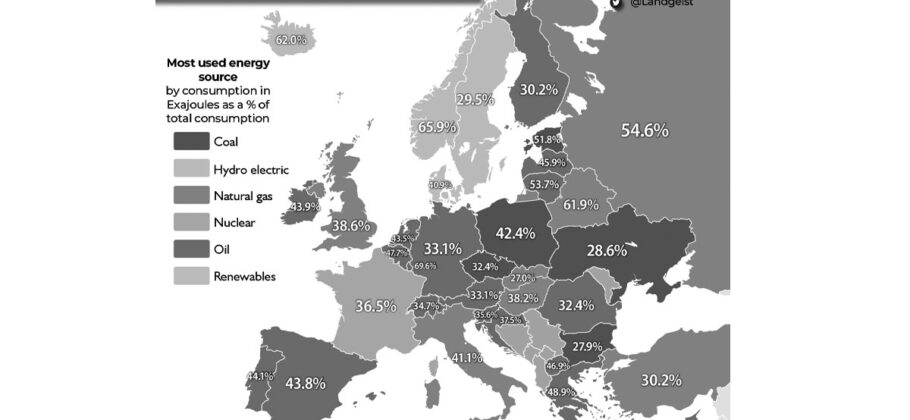
Still, natural gas continues to account for about a quarter of Europe’s total energy needs.
The Lesson Europe Must Learn
Europe’s experience over the past few years shows that energy dependence carries real risks. Russia used gas as leverage. The United States now supplies a dominant share of LNG. China dominates much of the clean energy supply chain.
Each path creates new forms of vulnerability.
The long-term solution, according to many European leaders and analysts, is clear. Reducing reliance on imported fossil fuels and expanding domestic renewable energy offers the best chance of lowering costs, protecting industry, and preventing foreign governments from using energy as leverage.
As Energy Commissioner Dan Jorgensen put it, “We’ve chosen energy security and independence for Europe. No more blackmail. No more market manipulation.”
For Europe, the challenge is not just ending one dependency. It is avoiding the trap of replacing it with another.