
The United States is preparing to take a historic step back onto the Moon, not just to visit, but to stay. NASA has unveiled an ambitious plan to build a permanent lunar base, a transformative project that signals a new era of exploration, innovation, and national pride.
At the center of this announcement is a major strategic shift. NASA is moving away from its previous Lunar Gateway concept, which was designed as a space station orbiting the Moon, and is instead focusing directly on building infrastructure on the lunar surface. As NASA Administrator Jared Isaacman explained, “It should not really surprise anyone that we are pausing Gateway in its current form and focusing on infrastructure that supports sustained operations of the lunar surface.”
This pivot reflects a clear vision. Rather than orbiting the Moon, the future of exploration will happen on it.
A Mission of Scale and Determination
The Moon base is expected to cost approximately $20 billion over the next seven years, with some estimates reaching $30 billion over the next decade.
Isaacman made clear that this is not just another space project, but a national mission with global implications. “NASA is committed to achieving the near-impossible once again, to return to the Moon… build a Moon base, establish an enduring presence, and do the other things needed to ensure American leadership in space,” he said.
The urgency behind the effort is unmistakable. “The clock is running in this great-power competition, and success or failure will be measured in months, not years.”
This is not incremental progress. It is a decisive leap.
What the Moon Base Will Become
NASA’s vision for the lunar base is expansive and highly capable. The base will include permanent habitats, scientific laboratories, advanced communications systems, power generation sources including solar and nuclear, and even local manufacturing capabilities.
It is designed to support long-duration human presence, with plans to host astronauts on extended missions. In its final phase, the base is expected to support four astronauts for missions lasting about four weeks at a time.
This is not a temporary outpost. It is the foundation of a permanent human foothold beyond Earth.
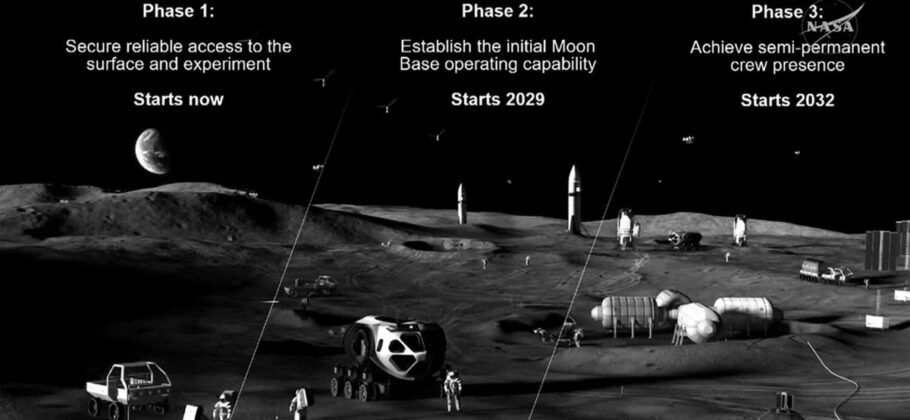
NASA has laid out a clear, phased roadmap for constructing the Moon base.
The first phase, described as “build, test, and learn,” focuses on deploying robotic systems, communication networks, and early technologies. This phase will include rovers, drones capable of traveling long distances, and systems to test power generation and navigation on the lunar surface.
The second phase shifts toward infrastructure. NASA will establish semi-habitable systems and begin recurring astronaut missions, supported by international partners and larger payload deliveries.
The final phase enables long-term human presence. This includes full habitats, advanced mobility systems, and an “industrial neighborhood” capable of supporting manufacturing and sustained operations.
Each phase builds on the last, turning a distant goal into a structured and achievable reality.
The Moon base is more than a technological achievement. It serves multiple critical purposes.
NASA emphasizes that surface operations provide advantages in safety, technology demonstration, and scientific discovery. The base will also serve as a testing ground for future missions to Mars, offering insights into how humans can live and work beyond Earth.
It will enable researchers, students, and engineers to conduct experiments in a new environment, opening the door to discoveries that are impossible on Earth.
In essence, the Moon becomes a stepping stone to the rest of the solar system.
A Demanding Challenge
Building a base on the Moon is not easy. NASA must overcome extreme temperature swings, intense radiation, low gravity that affects the human body, and constant impacts from micrometeorites.
Yet NASA leadership has embraced the challenge with clarity and resolve.
“We are not going to sit idly by while schedules slip or budgets are exceeded,” Isaacman said, signaling a new era of accountability and execution.
This determination reflects a broader shift in how NASA intends to operate moving forward.
The timeline for this effort is aggressive. The United States aims to return astronauts to the Moon by 2028, marking the first human landing since the 1970s.
From there, missions are expected to increase in frequency, with the goal of landing astronauts as often as every six months as capabilities improve.
This rapid cadence is essential to building momentum and turning plans into reality.
American Pride in Going to the Moon
For years, critics have questioned NASA’s direction. Billions were spent, timelines slipped, and progress often felt slow. But this announcement marks a turning point.
The agency now has a clear mission, a focused strategy, and the determination to execute. As one program leader put it, “It’s very clear that we need to be focused on one thing… this is a game-changer. It’s quite incredible.”
The Moon base is more than a project. It is a statement.
It represents American leadership, human ambition, and the willingness to take on challenges that once seemed impossible.
If successful, it will not only return humanity to the Moon, but establish a permanent presence that reshapes our future in space.