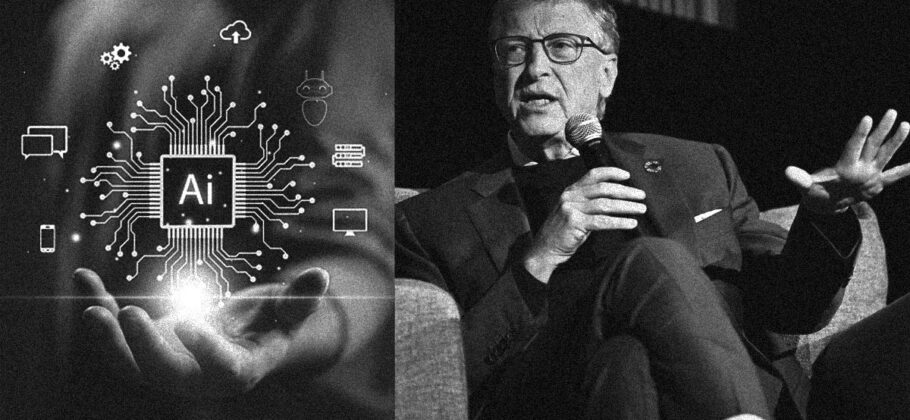
The warnings are no longer coming from fringe voices or distant futurists. They are coming from one of the most influential figures in modern technology. Bill Gates, the co-founder of Microsoft and a man who helped shape the digital age, is now sounding the alarm about what comes next.
His message is stark. As artificial intelligence accelerates, most jobs are at risk. Only a small number will survive in their current form.
And if Gates is right, the implications for millions of workers are deeply unsettling.
Bill Gates is not just another tech executive offering speculation. He is a billionaire who helped build one of the most powerful companies in history and spent decades at the forefront of technological change.
When he speaks about the future of computing, people pay attention. As the text notes, “many tend to listen,” given his role in pioneering the computer revolution.
AI Is Already Replacing Jobs
The shift is not theoretical. It is already happening.
Companies are rapidly integrating AI into daily operations. Some see it as revolutionary. Others see it as a direct threat to their livelihoods. In fact, a study cited in the material shows that British companies reported net job losses due to AI over the past 12 months, with an eight percent decline.
Even Microsoft has identified dozens of roles at risk. And the list is not limited to low skill work.
It includes:
- Interpreters and translators with a 98 percent overlap
- Historians at 91 percent
- Mathematicians at 91 percent
- Proofreaders at 91 percent
- Automatic machine coders at 90 percent
- Writers and authors at 85 percent
- Statistical assistants at 85 percent
- Sales representatives at 84 percent
- Technical writers at 83 percent
- Journalists at 81 percent
These are not fringe roles. These are knowledge workers. Many of them spent years developing expertise that is now being challenged by machines. And while some researchers try to soften the message by saying AI is meant to assist rather than replace, the broader trend tells a different story. Companies are cutting costs. AI is cheaper. And the incentives are clear.
The Three Jobs Gates Says Will Survive
Against this backdrop, Gates identifies just three categories of work that he believes will endure.
Coders
Ironically, the people building AI may be the ones most protected from it. Gates argues that while AI can generate code, it still lacks the precision needed for complex systems. Humans are required for debugging, refining, and advancing these systems.
“The bottom line is that AI needs people behind it to manage everything.”
He even suggests that coding could remain a human dominated profession for decades, possibly even 100 years.
But there is a contradiction here that should not be ignored. Companies, including Microsoft itself, are already replacing coding staff with AI tools. That suggests that while top tier engineers may survive, many others will not.
Biologists
The second safe category is biology, especially in areas like medical research and scientific discovery.
Gates points to creativity and critical thinking as key advantages that AI cannot replicate. While machines can analyze data and diagnose illnesses, they struggle to generate new ideas or groundbreaking hypotheses.
“AI can’t make progress in revolutionary research or formulate new hypotheses.”
In this field, AI is a tool, not a replacement. At least for now.
Energy Workers
The third group is those working in energy.
From oil to nuclear to renewables, the energy sector is vast and highly complex. It involves not just engineering, but economics, politics, and crisis management. Gates believes AI can assist with analysis, but humans will remain essential for decision making.
“Human speciality is paramount when it comes to decision making, especially when it comes to energy, and especially if it involves crisis management.”
In other words, when the stakes are high and the systems are complex, humans are still needed.
A Future That Should Worry Tech Workers
What makes Gates’ warning especially troubling is not just what he says, but what is already happening. Microsoft has laid off thousands of employees even as AI becomes more central to its strategy. That is not a coincidence. It is a signal.
Big Tech is not slowing down. It is accelerating. AI is not being deployed cautiously. It is being deployed aggressively, often at the expense of workers. And if one of the most influential companies in the world is willing to make those moves, others will follow.
This is the real story behind Gates’ prediction.
It is not just about which jobs survive. It is about how quickly companies are willing to replace the ones that do not.
To his credit, Gates admits he could be wrong. He compares the rise of AI to the Industrial Revolution and the internet, both of which reshaped the world in ways few could predict.
But that uncertainty cuts both ways. If AI evolves faster than expected, even the “safe” jobs may not be safe for long. And if companies continue to prioritize efficiency over people, the transition could be brutal.
For now, Gates offers a narrow path forward. Coding, biology, and energy may hold out longer than others.
FAM Editor: Ironically, we believe that older folks who embrace AI could turn into big winners. It is true that many of us may not be nimble enough to pick up the latest and greatest coding languages. But in the case of engineers, the older education grounded in theory plus the experience with change over the last decades could combine with AI to be much more powerful. Our view of the world is broader, our understanding of the workings of the world is deeper.
For some in the younger generations who grow up with AI, it could easily become a crutch that replaces the real world.
But this will take some effort on the part of us old geezers.