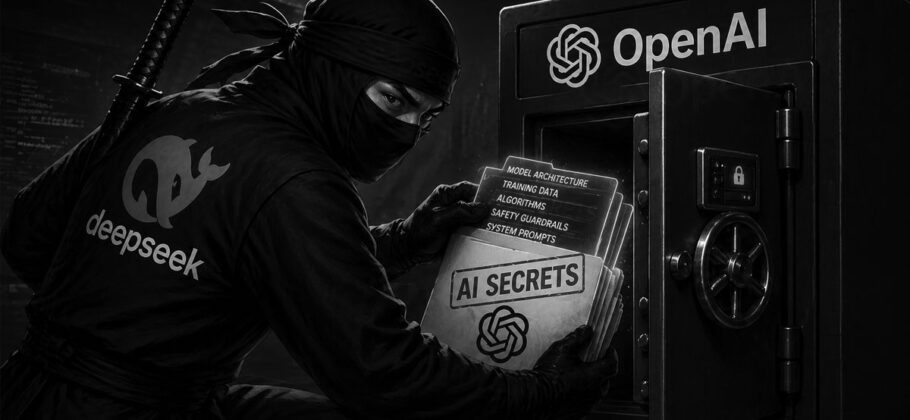
A growing confrontation over artificial intelligence is unfolding at the highest levels of government. The White House and the U.S. State Department are warning that Chinese technology firms, including DeepSeek, are engaged in what officials describe as large-scale efforts to extract and replicate American AI systems.
These accusations are rooted in an internal State Department cable and a White House memo that together outline a coordinated concern about how advanced AI models are being copied, repackaged, and redeployed abroad.
DeepSeek is a Chinese AI startup that has rapidly gained global attention by producing high-performing models at a fraction of the cost of its American competitors. Its earlier systems stunned the industry, and its newly released V4 model highlights China’s increasing independence in AI development.
The company claims its models rely on publicly available data and web crawling. However, U.S. officials and leading AI firms argue that the reality may be very different. They point to patterns suggesting that DeepSeek and similar firms may be leveraging American AI outputs in ways that cross into intellectual property theft.
The core accusation is that foreign actors are systematically copying advanced AI systems developed in the United States. According to the White House, these efforts are designed to “systematically undermine American research and development and access proprietary information.”
Officials describe this as an organized campaign involving thousands of interactions with AI systems. The goal is not just to use these systems, but to extract enough information to recreate them.
The State Department cable goes even further, warning that these efforts allow foreign companies to release competing products that appear similar to U.S. models while avoiding the massive costs required to build them from scratch.
The Mechanics
At the center of the controversy is a technique known as distillation. This process involves training a smaller AI model using the outputs of a larger, more advanced system.
In legitimate settings, distillation is a recognized method for improving efficiency. However, U.S. officials argue that it is being used in unauthorized ways. According to the White House memo, foreign actors create large numbers of accounts that interact with AI systems, asking questions and collecting responses.
These accounts often attempt to “jailbreak” the systems, meaning they try to bypass safeguards and extract information that is not intended to be shared. The collected outputs are then used to train new models that mimic the behavior of the originals.
The State Department cable describes these efforts as “surreptitious, unauthorized distillation campaigns,” emphasizing that they are not open or permitted uses of the technology.
The primary victims are leading U.S. AI companies, including OpenAI and Anthropic. Both firms have warned lawmakers about attempts to replicate their systems.
OpenAI has specifically accused DeepSeek of targeting its technology, while Anthropic has reported similar activity from multiple Chinese labs, including DeepSeek, Moonshot AI, and MiniMax.
These companies invest billions of dollars into developing advanced AI. If their systems can be copied at low cost, it threatens both their business models and the broader U.S. technological advantage.
Several factors have raised suspicion among U.S. officials and AI companies. One is the speed at which some foreign models have advanced, despite relatively low reported development costs. DeepSeek’s claim that it built a competitive system for under $6 million has drawn particular scrutiny.
Another indicator is the pattern of interactions with AI systems. The use of thousands of accounts engaging in coordinated behavior suggests a systematic effort rather than normal usage.
There is also the issue of performance similarities. Some foreign models appear to closely match the outputs of leading U.S. systems, raising questions about how they achieved those results so quickly.
China’s Response
China has firmly rejected the accusations. The Chinese Embassy in Washington called them “groundless” and described them as deliberate attacks on the country’s technological progress.
DeepSeek itself has denied intentionally using proprietary data from U.S. companies, maintaining that its models rely on publicly available information.
These allegations come at a sensitive moment. Donald Trump is preparing for a visit to Beijing to meet with Xi Jinping.
The dispute over AI theft threatens to escalate tensions in an already intense technological rivalry between the United States and China. What had been a fragile easing of tensions could quickly unravel as both sides harden their positions.
Artificial intelligence is no longer just a commercial competition. It has become a central battleground in global power dynamics.
The White House warning signals that the United States sees the protection of AI technology as a national priority. At the same time, the rapid rise of companies like DeepSeek shows that the race is accelerating.
FAM Editor: This is not just theft by a Chinese company, it is a concerted effort supported by Chinese intelligence as part of their massive tech theft activities. In short, no one is going to jail for this.