A Manufacturing Powerhouse Under Pressure
For generations, Germany stood as Europe’s industrial engine, admired for its precision manufacturing, global exports, and world-famous companies. Automakers, chemical giants, and advanced manufacturers helped make the country an economic powerhouse. But today, growing evidence suggests Germany is facing something much darker: a slow industrial death spiral fueled by rising costs, shrinking competitiveness, and policies that critics say are undermining the country’s economic foundations. The warning signs are mounting, from disappearing automotive jobs to factory closures and even fears among businesses about simple survival.
Germany’s Vanishing Automotive Jobs
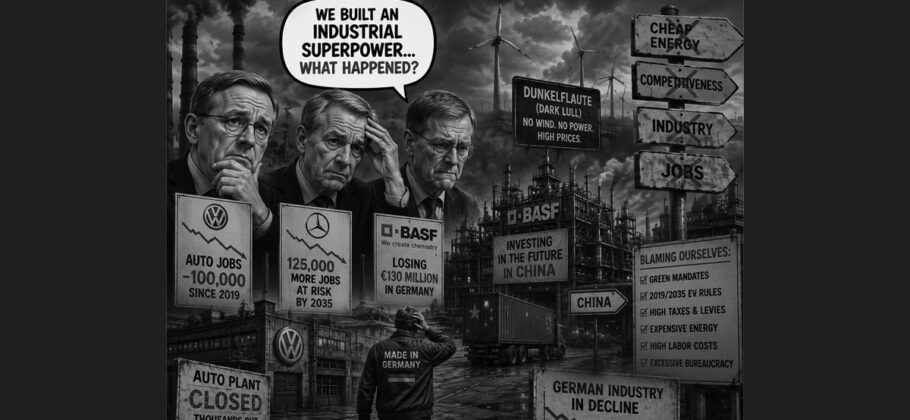
Few industries better represent Germany than automobiles. Yet the country’s signature manufacturing sector is shrinking at an alarming pace. According to the German Association of the Automotive Industry, or VDA, Germany has lost roughly 100,000 automotive-related jobs since 2019. Worse still, another 125,000 jobs, roughly one in six remaining positions in the industry, are projected to disappear by 2035.
The VDA cites several reasons for the decline, but one of the most significant is the European Union’s push toward electric vehicles. Under rules finalized by the EU, all new passenger cars and vans sold after 2035 must be zero-emission vehicles, effectively ending the sale of new gas, diesel, and hybrid vehicles. Automakers must also meet a 55 percent emissions reduction target by 2030 compared to 2021 levels. Critics inside the industry argue that these deadlines are too rigid and economically dangerous.
The VDA estimates that more than 50,000 German auto jobs are directly threatened by the transition away from combustion engines. Electric vehicles are simply less complex and require fewer parts, meaning fewer workers are needed to build them. At the same time, automakers are struggling with broader economic pressures that make adaptation even harder. The VDA points to “high taxes and levies, expensive energy, high labor costs, excessive bureaucracy,” describing a business environment that is becoming increasingly uncompetitive.
Other executives have voiced growing alarm. BMW chief executive Oliver Zipse reportedly called the EU timeline a “huge mistake,” while Mercedes-Benz chief executive Ola Källenius warned Europe was “driving full speed into the wall.” Volkswagen financial chief Arno Antlitz described collapsing demand in blunt terms: “It’s not to do with our product or poor performance. The market is simply not there any more.”
One in Twelve Companies Fear for Survival
Germany’s problems extend well beyond automobiles. According to the Munich-based Ifo Institute, one in twelve German companies is now worried about its survival. The reasons are familiar and increasingly severe: burdensome bureaucracy, rising costs, taxes, labor expenses, and soaring energy prices. Germany ranked just 30th among 38 OECD nations on corporate taxes in the Tax Foundation’s 2025 index, highlighting concerns about competitiveness.
Many business leaders increasingly view the problem as structural rather than temporary. What once looked like a short-term downturn now resembles a long-running deterioration in Germany’s ability to compete globally.
Hans-Jürgen Völz, chief economist at BVMW, offered perhaps the starkest assessment. “One sometimes hears about ‘creeping deindustrialization’,” he warned. “Well, it’s not just creeping anymore.” His comment captures growing anxiety that Germany’s industrial decline is accelerating rather than stabilizing.
BASF Sends a Powerful Warning
If Germany’s troubles needed a symbol, BASF may be the clearest example. For more than 150 years, BASF stood as one of the pillars of German manufacturing, deeply rooted in Ludwigshafen and synonymous with German industrial excellence. Yet BASF is increasingly looking elsewhere.
The company announced a massive $10 billion investment in a new industrial complex in China while simultaneously scaling back operations at home. BASF closed facilities in Germany, including a fertilizer plant in Ludwigshafen, eliminating roughly 2,600 jobs. BASF chief executive Martin Brudermüller revealed the company lost €130 million in Germany in a single year, underscoring what he described as a profitability crisis.
The message from BASF is difficult to ignore. One of Germany’s most historic industrial champions is increasingly investing abroad while shrinking domestically. Rather than expanding in Europe’s largest economy, BASF is turning toward China in search of stronger growth and more competitive operating conditions. Critics see this not as an isolated business decision, but as evidence of a broader industrial retreat.
Climate Policy, Energy, and the Industrial Crunch
At the center of the debate is Germany’s energy policy and Europe’s climate agenda. Critics argue that climate policies designed to force rapid decarbonization are colliding with economic reality.
Germany shut down nuclear plants while expanding renewable energy generation, but critics argue the renewable system remains unreliable and insufficient for industrial needs. During periods known as “Dunkelflaute,” meaning dark lull, solar and wind generation fall sharply due to cloudy and windless conditions. When this happens, Germany has been forced to rely on imported electricity, burn coal, or scramble for expensive natural gas supplies.
Sweden’s Energy Minister Ebba Busch criticized Germany’s energy model directly, saying, “Germany’s energy system isn’t right. It is a result of decommissioned nuclear power. When it’s not windy, we get high electricity prices.” Meanwhile, RWE chief executive Markus Krebber warned, “We still have problems with gas supply. If we really want to be independent of Russian gas, we need to have more import capacity.”
For automakers, this energy instability creates an additional burden. Europe’s climate rules are forcing companies toward electric vehicles at the very moment energy systems remain fragile and expensive. Critics argue this creates a dangerous contradiction: automakers are expected to produce an all-electric future while manufacturers face soaring energy costs and uncertain electricity supply.
Germany’s industrial model once rested on abundant energy, competitive manufacturing, and engineering excellence. Today, those foundations appear increasingly strained. With lost jobs, factory closures, business anxiety, and industrial giants redirecting investment abroad, many fear Germany is no longer experiencing a temporary slump but something far more serious: an industrial death spiral.