
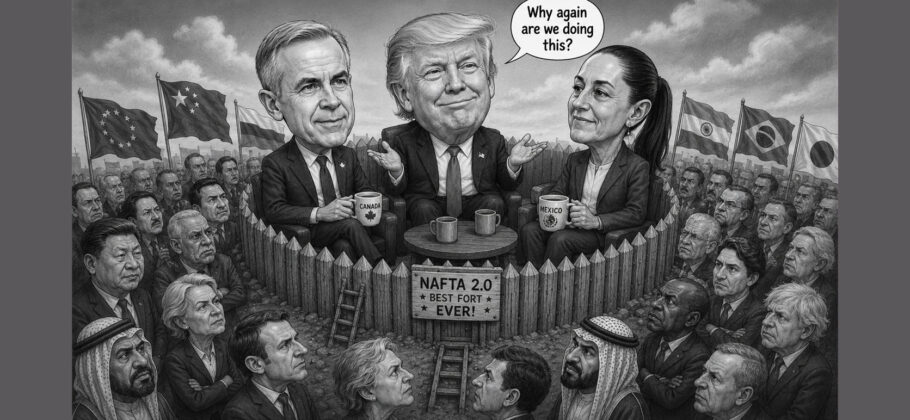
The idea of “Fortress North America” is rapidly emerging as one of the most important concepts in the future of trade and security across the continent. What began as a phrase used by business leaders and politicians is now evolving into a serious proposal for a renewed partnership between the United States, Canada, and Mexico. Supporters argue that it could become something stronger and more strategically focused than NAFTA or its successor agreements, creating a continental alliance that combines economic power, industrial strength, energy security, and protection against geopolitical rivals, particularly China.
At its core, Fortress North America is based on a simple idea. Rather than treating trade as an abstract exercise in globalization, the three countries would build a tightly integrated economic and security bloc designed to strengthen North American industries, secure critical supply chains, protect strategic technologies, and compete more effectively against global rivals. Advocates believe the United States would provide the leadership and economic muscle while Canada and Mexico would contribute resources, manufacturing capacity, energy production, and geographic depth.
What Fortress North America Would Look Like
The emerging vision centers on several major pillars.
First, it would deepen supply chain integration. North American auto manufacturing, steel production, agriculture, critical minerals, energy production, and advanced technology sectors would become even more interconnected. Supporters argue that billions of dollars in new investment could be unlocked if companies were confident that the continent would remain a stable and unified production platform.
Second, it would strengthen energy cooperation. Canada possesses enormous reserves of oil, natural gas, uranium, hydroelectric power, and critical minerals. Mexico contributes manufacturing capacity and strategic geography. The United States provides the world’s largest economy and the most advanced capital markets. Together, supporters believe the three countries could become largely self-sufficient in many strategic industries.
Third, it would create a stronger security perimeter. Rather than viewing economic and national security as separate issues, Fortress North America treats them as closely linked. Advocates argue that secure supply chains for nuclear energy, defense manufacturing, rare earth minerals, semiconductors, and advanced technologies are essential to long-term national security.
Finally, the concept would likely include coordinated approaches toward imports from countries viewed as unfair competitors. Several advocates have specifically pointed to China as the principal strategic challenge facing North American industry.
Doug Ford and the Push for Continental Integration
One of the most outspoken supporters of Fortress North America is Ontario Premier Doug Ford.
Ford has become a leading advocate for replacing trade disputes with deeper continental cooperation. In his recent remarks, he argued that tariffs and uncertainty harm workers and businesses on both sides of the border while benefiting competitors abroad. His vision emphasizes practical economic integration rather than confrontation.
Ford points out that Ontario is deeply intertwined with the American economy. The province supplies critical minerals, rare earths, electricity, uranium, manufacturing inputs, food products, and other strategic resources. He argues that Canada and the United States already “build things together” and that a renewed agreement could create a jobs boom, reduce consumer costs, and strengthen continental security. Ford views China as a major competitive challenge and believes North America can respond more effectively through unity than through internal trade conflicts. He has repeatedly argued that economic security is national security and that the continent’s greatest strength lies in cooperation among allies rather than disputes between them.
Mark Carney and the Strategic Case
Canadian Prime Minister Mark Carney has also embraced the concept, although with a more cautious political approach.
Carney recently stated that Canada remains open to deeper integration with both the United States and Mexico and indicated that “offers are on the table” regarding Fortress North America. His interest appears heavily focused on energy, investment, and critical minerals. Carney wants Canada to become what he calls an “energy superpower,” and he recognizes that the United States remains Canada’s largest and most important market.
Carney’s strategy appears designed to balance two competing realities. On one hand, many Canadians remain wary of excessive dependence on the United States. On the other hand, the economic benefits of closer integration remain difficult to ignore. Carney has attempted to frame Fortress North America not as a surrender of sovereignty but as a mutually beneficial partnership. His message is that integration works when all parties benefit and when no country becomes subordinate to another. Supporters argue that his willingness to discuss deeper integration reflects a recognition that North America faces increasing competitive pressure from China and other global rivals.
Tim Hodgson and the Energy Argument
Canadian Energy Minister Tim Hodgson has emerged as another key advocate.
Hodgson has argued directly to American audiences that Fortress North America could help the United States achieve energy dominance. His focus is on integrating Canadian energy resources with American industrial and strategic goals. He sees opportunities in critical minerals, mining projects, electricity production, and energy infrastructure.
The logic is straightforward. The United States needs secure supplies of energy and critical minerals. Canada possesses many of those resources. By aligning investment and development priorities, both countries could strengthen their competitive position while reducing dependence on less reliable foreign suppliers. This argument has particular appeal as competition with China increasingly shapes economic policy discussions throughout North America.
Who Is Talking to Trump?
The concept has gained traction among business leaders, policymakers, and trade advocates on both sides of the border. Business organizations have increasingly adopted the language of Fortress North America during trade discussions and hearings involving the future of the United States-Mexico-Canada Agreement.
According to testimony discussed in trade hearings, the phrase has spread from Canadian political circles into American policy discussions. Business groups increasingly frame continental integration not as traditional free trade but as a strategic alliance designed to strengthen North America’s position against foreign competitors. This shift aligns closely with President Trump’s emphasis on manufacturing, supply chains, industrial capacity, and economic nationalism.
What Critics Are Saying
Critics raise several concerns.
Some argue that Fortress North America risks making Canada and Mexico too dependent on American priorities. Others worry that closer integration could gradually erode national sovereignty or limit independent trade relationships with Europe and Asia.
Another criticism is that the fortress concept replaces the traditional language of free trade with a more defensive and protectionist framework. Some observers fear that defining North American cooperation primarily through economic security could make future global trade relationships more difficult.
Others question whether Canada’s efforts to diversify trade relationships can coexist comfortably with a strategy that emphasizes tighter continental alignment. They argue that Canada may eventually face difficult choices between broader global engagement and closer North American integration.
A Potential Successor to NAFTA
Supporters believe those concerns are outweighed by the opportunities. Unlike NAFTA, which was largely framed around lowering trade barriers, Fortress North America is being presented as a comprehensive economic and security partnership. Its advocates argue that it reflects the realities of modern competition, where supply chains, critical minerals, energy resources, advanced technologies, and national security are increasingly interconnected.
If President Trump ultimately embraces the concept, supporters believe he could become the principal architect of a new continental framework. Canada and Mexico would gain access to the economic strength and security umbrella of the United States, while America would gain more secure borders, more resilient supply chains, stronger industrial capacity, and trusted partners in an increasingly competitive world.
In that vision, Fortress North America would not simply replace previous trade agreements. It would redefine North America as a strategic alliance built around shared prosperity, industrial strength, and continental security for the decades ahead.
FAM Editor: This probably raises more questions than it answers. Is Fortress America going to be an equivalant of the EU? Will Canada and Mexico just become states of the U.S. And what about the currect friction between the U.S. and Canada? And what about the narco cartel control of the Mexican government? Will Trump view this as an opportunity or a trap?