
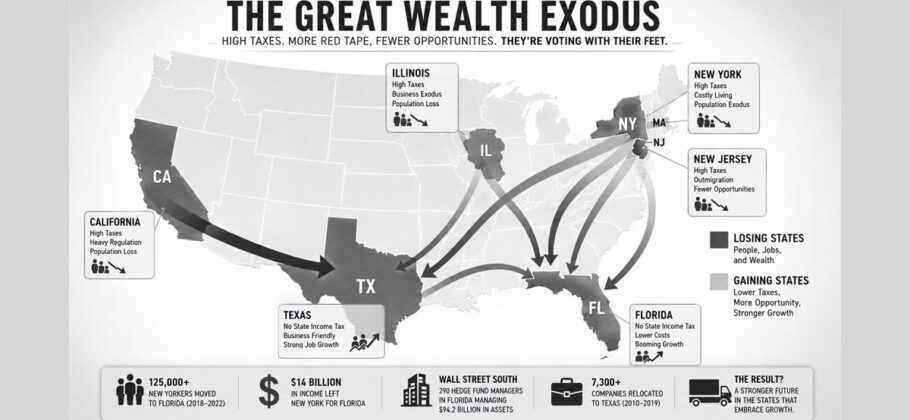
Wall Street Journal columnist Kimberley Strassel, in her opinion piece argues that America is witnessing a real-world competition between two economic models. On one side are states that emphasize lower taxes, lighter regulation, and policies designed to attract businesses and investment. On the other are states and cities that increasingly rely on higher taxes, redistribution, and government intervention. According to Strassel, the results are becoming increasingly difficult to ignore, and nowhere is the divide more visible than in New York City.
The latest flashpoint came when New York Mayor Zohran Mamdani publicly targeted Citadel founder Ken Griffin while promoting a new tax on owners of expensive second homes. Mamdani complained that wealthy property owners do not pay their fair share and pointed to Griffin’s $238 million New York penthouse as an example. Griffin responded by saying the criticism only reinforced his belief that moving Citadel’s headquarters from Chicago to Miami in 2022 had been the right decision.
Speaking at the Milken Institute conference, Griffin praised Florida as a state that embraces business, personal freedom, and economic opportunity. He contrasted that with what he described as a culture of redistribution and dependency. Mamdani fired back by arguing that New York’s tax system remains unfair and that higher taxes on wealthy residents are necessary to make the city affordable for working people.
The dispute highlights a growing question facing New York and other progressive cities: what happens when governments increasingly target the individuals and companies that provide a substantial share of the tax base? Critics of Mamdani’s approach argue that the answer is already becoming visible as people, wealth, and businesses continue to leave for states that offer a friendlier economic climate.
The Numbers Behind the Exodus
The migration away from New York is no longer anecdotal. According to the information cited by Strassel, more than 100,000 people left New York City last year alone. The city continues to struggle with some of the highest tax burdens in the nation, including combined state and local income tax rates that can approach 15 percent for top earners.
Meanwhile, Florida has emerged as one of the largest beneficiaries of that outflow.
Between 2018 and 2022, more than 125,000 New Yorkers relocated to Florida, taking nearly $14 billion in income with them. Many settled in Miami-Dade, Palm Beach, and Broward counties. The movement represents more than a simple change of address. It reflects a transfer of economic activity, investment capital, consumer spending, and future tax revenue.
Economist Peter Earle summarized the issue bluntly when he observed that “the lifestyle of the masses is silently carried on the shoulders of the few.” When those high earners leave, cities can lose far more than just wealthy residents. They also lose a disproportionate share of the revenue that supports public services.
Critics argue that this is the danger facing New York. Efforts to extract ever-higher taxes from top earners may ultimately encourage them to establish residency elsewhere, reducing the very revenue policymakers hope to collect.
The Rise of Wall Street South
The most visible winner of this migration has been South Florida.
Over the past several years, Miami and neighboring communities have transformed from vacation destinations into legitimate financial centers. The region has attracted hedge funds, private equity firms, investment managers, family offices, and financial service companies that once viewed New York as the only place to do business.
The trend has become so pronounced that Miami is now frequently referred to as “Wall Street South.”
The numbers help explain why. The number of hedge fund managers headquartered in Florida reportedly increased from 193 at the end of 2019 to 290 within just a few years. Together, those firms manage approximately $94.2 billion in assets.
Local economic development officials say the inquiries have never stopped. According to Miami-Dade Beacon Council executive James Kohnstamm, the pace accelerated following federal tax reforms in 2017 and then surged again during the Covid era. What began as a gradual trend became a flood of talent, followed by company relocations.
The appeal extends beyond taxes. Business leaders frequently cite lower costs, better quality of life, reduced regulation, and public safety concerns as reasons for relocating operations and employees.
The Billionaires and Firms Heading South
Ken Griffin may be the most recognizable face of the migration, but he is hardly alone.
Some of the biggest names in finance have established major operations or residences in Florida, including Carl Icahn, Dan Sundheim, Jesse Cohn, Jon Pollock, and Scott Shleifer.
Major firms with significant Florida footprints include Goldman Sachs, Apollo Global Management, Point72 Asset Management, Elliott Management, D1 Capital Partners, Tiger Global Management, and Virtu Financial.
Virtu Chief Executive Officer Doug Cifu noted one of the clearest advantages of relocating employees to Florida: the absence of a state income tax. For many highly compensated professionals, that translates into a substantial increase in take-home pay without any change in salary.
The movement has become large enough that local officials are actively competing for additional relocations. Boca Raton Mayor Scott Singer recently made a direct appeal to New York businesses, declaring, “We’re here to celebrate business, not regulate it.”
Singer pointed to Florida’s lack of state income tax, relatively low property taxes, and emphasis on public safety as major advantages. He also reported receiving inquiries from companies interested in relocating following New York’s recent political developments.
Texas, Too
Florida is not the only state benefiting from the migration.
Texas has spent decades building a reputation as one of the most business-friendly states in America, and it is now reaping the rewards.
Tesla moved its headquarters to Texas in 2020. Hewlett Packard Enterprise and Fisher Investments also relocated. Dallas is preparing to host NYSE Texas, a new branch of the New York Stock Exchange that further reinforces the state’s growing importance in American finance.
According to the Federal Reserve Bank of Dallas, more than 7,300 firms relocated to Texas between 2010 and 2019.
State leaders have combined low taxes, relatively light regulation, and a growing labor force to create an environment that continues attracting businesses from California, New York, Illinois, and elsewhere.
California’s Warning Sign
New York is not the only state facing concerns about wealth flight.
California is currently considering a proposed Billionaire Tax Act that would impose a one-time 5 percent tax on the net worth of billionaires. Supporters claim the measure could generate approximately $100 billion for healthcare and education programs.
Opponents warn that the proposal risks accelerating a trend that is already underway.
California has experienced significant population losses in recent years, with Florida and Texas emerging as major destinations for departing residents and businesses. Critics argue that a direct tax on wealth could push even more entrepreneurs, investors, and company founders to relocate.
Economist Enrico Moretti warned that such policies could increase the likelihood that billionaires move while reducing the incentive for future investment.
For many observers, the California debate resembles a larger national argument over whether governments can continue raising taxes on a shrinking pool of high-income taxpayers without eventually encouraging them to leave.
A Tale of Two Economic Models
The debate sparked by Mamdani and Griffin ultimately reaches far beyond New York City. It reflects a broader competition between states pursuing dramatically different visions of economic policy.
One model emphasizes lower taxes, business formation, investment, and competition for employers. The other places greater emphasis on redistribution, social programs, and higher taxes on top earners.
Americans are increasingly making choices based on those competing visions.
Businesses that once felt obligated to remain in Manhattan or Silicon Valley now have alternatives. Workers who once moved primarily for weather or job opportunities are increasingly weighing taxes, housing costs, crime rates, and overall quality of life.
Florida, Texas, Tennessee, Georgia, Utah, and the Carolinas continue attracting residents and investment. Meanwhile, states such as New York, California, Illinois, and New Jersey continue to struggle with outbound migration.
Whether one agrees with Strassel’s conclusions or not, the migration itself is undeniable. The moving trucks, corporate relocations, and billions of dollars shifting across state lines suggest that economic policy is becoming one of the most important factors shaping where Americans choose to live and work.
And for now, the flow remains overwhelmingly in one direction.